Birch trees are a homeowner’s dream, elegant white trunks, delicate foliage that dances in the breeze, and reliable four-season interest that keeps your front yard looking polished whether it’s summer’s lush green or winter’s stark silhouette. Unlike heavy maples or sprawling oaks, birch trees offer a sense of scale that works in modest yards while still commanding attention. They’re not just pretty, either. These trees are surprisingly tough, deer-resistant, and relatively low-maintenance once established. If you’re thinking about adding a birch tree to your front yard, this guide walks you through everything from site selection to seasonal care, the kind of honest, practical advice that’ll save you headaches and help your tree thrive.
Table of Contents
ToggleKey Takeaways
- Front yard birch tree landscaping provides year-round visual interest with distinctive white bark, dappled shade, and natural form without heavy pruning requirements.
- Success with birch trees depends on choosing a location with at least six hours of sun, proper drainage, good air circulation, and cool, moist soil that’s amended with compost if needed.
- Water newly planted birch trees deeply and regularly (1–2 inches weekly) for the first two years, and apply 2–3 inches of mulch kept 3–4 inches away from the trunk to prevent disease and pest problems.
- The dappled shade cast by birch trees allows you to plant shade-tolerant understory plants like ferns, hostas, and hellebores, creating layered landscape designs that frame the tree as an architectural focal point.
- Birch trees are naturally deer-resistant, relatively low-maintenance once established, and perform best with minimal pruning in early spring and consistent summer monitoring for pests like birch leaf miners.
- Season-specific care—spring pruning, summer watering consistency, fall cleanup, and winter dormancy—keeps your birch healthy without requiring supplemental fertilizer or heavy intervention.
Why Birch Trees Make Excellent Front Yard Focal Points
Birch trees deliver visual impact with minimal fuss. The distinctive white, cream, or peeling bark creates year-round interest, something you simply can’t replicate with shrubs or perennials alone. In summer, the fine-textured foliage casts dappled shade and moves gracefully in wind. Come fall, that canopy turns a buttery gold before dropping cleanly in winter, when the trunk itself becomes the focal point.
They’re also compact relative to their impact. Most front-yard-suitable varieties like paper birch and river birch max out at 40–50 feet tall (and often shorter), making them manageable for residential lots without towering over the house. Unlike crabapples or ornamentals that need heavy pruning, birches are naturally well-shaped.
From a practical standpoint, birch trees are deer-resistant, which matters if wildlife browse is an issue. They’re also less prone to the pests that plague other shade trees. And unlike maples, which create dense shade that kills turf underneath, birch dappled shade allows understory planting, meaning you can layer landscaping beneath without everything dying. This flexibility is why designers often feature birches in front yard landscaping schemes: they’re the anchor that makes everything else work.
Choosing and Preparing the Right Location for Planting
Success with birch trees hinges on choosing the right spot before you plant. These trees prefer full sun, at least six hours of direct light daily, though they tolerate partial shade in warmer zones. More importantly, birches like cool, moist soil. They perform best in regions with winters cold enough to satisfy dormancy requirements. If you live in zones 7 and warmer, look for dappled afternoon shade to keep roots cool during hot summers.
Drainage matters as much as moisture. Birches don’t tolerate wet feet year-round, so avoid low spots where water pools after rain. If your yard slopes toward a retention area or sits naturally boggy, that’s not your spot. Conversely, they struggle in compacted clay or sandy soils with poor water-holding capacity.
Before planting, test your soil or at least observe it. Squeeze a handful of moist soil. If it forms a tight ball that doesn’t crumble easily, you’ve got heavy clay, workable, but you’ll need to amend with compost. If it falls apart immediately, it’s sandy and will need organic matter to retain moisture.
Sunlight exposure, drainage, and air circulation are equally important. Birches are susceptible to birch leaf miner and canker diseases when stressed. Poor air circulation (planting too close to a fence, dense hedge, or building) creates humidity that invites fungal problems. In outdoor landscaping design, giving trees breathing room isn’t just about aesthetics, it’s preventive medicine.
Planting and Initial Care for Your Birch Tree
Soil Preparation and Planting Steps
Start with a planting hole dug slightly wider than the root ball and exactly as deep, not deeper. A common mistake is burying the base of the trunk (the flare where roots spread): that invites rot and collar rot disease. The root flare should sit at or just slightly above grade.
Amend native soil with 2 to 3 inches of compost mixed into the backfill if you’ve got clay or poor drainage. Don’t create an island of pure compost: roots must transition gradually to native soil or they’ll refuse to expand outward, girdling themselves in the planting hole.
Following these steps:
- Dig the hole (width at least 1.5× the root ball: depth = root ball height).
- Position the tree so the root flare is visible above grade.
- Backfill with native soil mixed with compost (about 20–30% compost by volume).
- Firm soil gently, don’t pack it hard, which excludes air.
- Water deeply to settle soil and eliminate air pockets.
- Do NOT use a planting amendment cone or fertilizer stake at planting. Young trees don’t need it, and it can burn roots.
If you’re planting in spring (best for birches in colder zones) or fall, timing gives roots a cool, moist season to establish. Avoid summer planting if possible: the heat stress is too much for a newly planted tree.
Watering and Mulching Best Practices
Water is your biggest job in year one and two. A newly planted birch needs deep, regular watering, about 1 to 2 inches per week during the growing season, depending on rain and heat. Stick your finger 2 inches into the soil: if it’s dry, water. If it’s moist, wait. Once a week slow, soaking irrigation (not a quick spray) is far better than daily sprinkles.
Mulch is essential but easy to get wrong. Apply 2 to 3 inches of wood chips around the base, keeping it 3 to 4 inches away from the trunk itself. Mulch piled against the trunk creates a habitat for rodents, bark-gnawing insects, and disease. Refresh mulch annually as it breaks down: decomposing mulch feeds soil biology and helps retain moisture.
Avoid mulch volcanoes, that pyramid of mulch smothered against the tree. It doesn’t help and it harms. A simple, loose ring is all you need. After two growing seasons of consistent moisture, most birches are established and can handle drought more gracefully, though they’ll perform better with occasional deep watering in very dry spells.
Designing Your Landscape Around Birch Trees
A birch tree is an architectural statement, so design around it, not against it. The dappled shade beneath lets you plant shade-tolerant perennials, groundcovers, or hostas rather than fighting to grow sun-lovers that’ll wilt and fade. Think of the tree canopy as creating zones: the drip line (outer edge) gets moderate shade and dry conditions: closer in, shade deepens and moisture is higher (the tree pulls it).
Understory planting options include ferns, astilbes, coral bells, hellebores, and shade-tolerant sedges, plants that thrive in cool, filtered light. These soften the base of the tree and hide the lower limbs (which birches naturally shed a little). Avoid heavy mulch beds entirely bare: planted beds are more forgiving of the occasional aphid drop and look intentional rather than neglected.
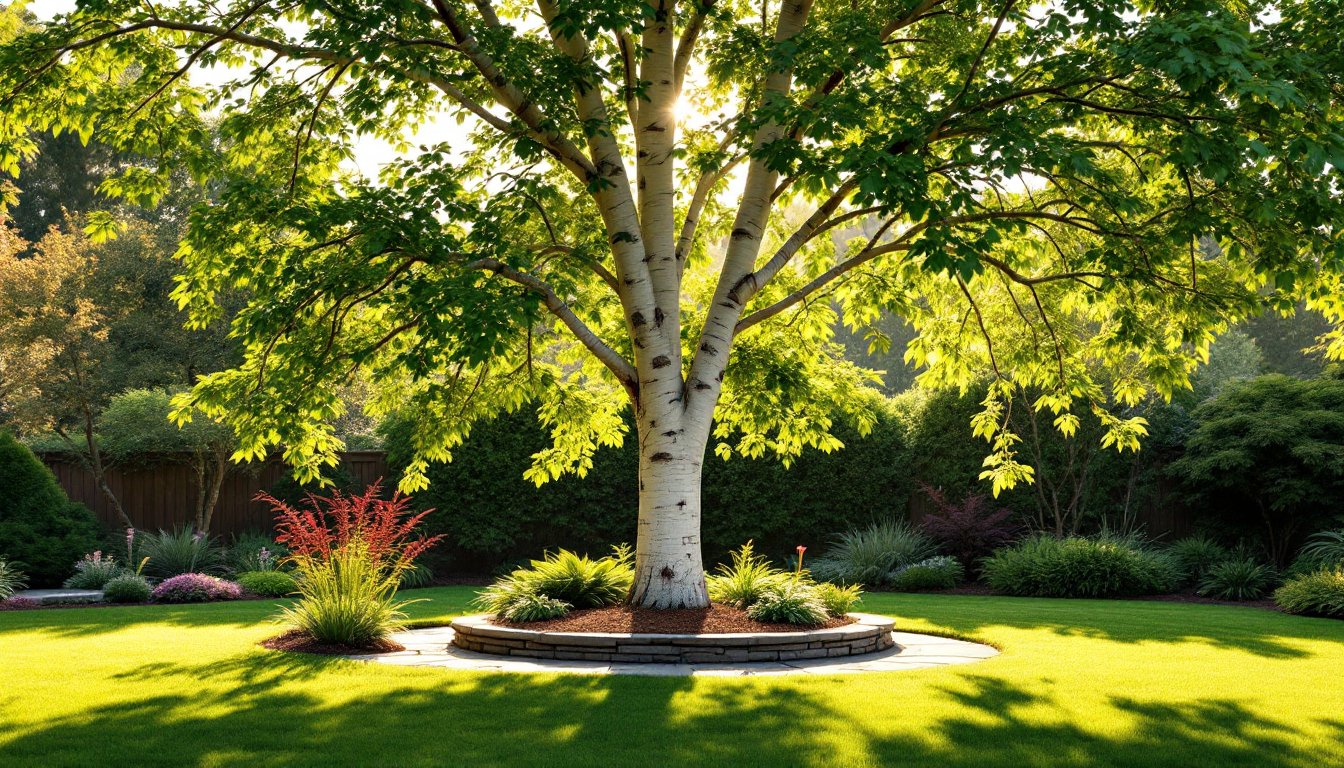
Hardscaping (stone, paths, seating) works beautifully under birch. The filtered light is perfect for a garden bench or a gravel seating area. A circular bench around the trunk, or a stone path snaking through the dappled shade, gives purpose to the space rather than leaving it as mowed turf. Many landscape designers feature birch tree designs in galleries, showcasing how white bark contrasts with slate, gravel, or dark perennials.
Scale matters. A single upright ‘Whitespire’ birch works in modest lots: multi-stem river birches suit larger spaces. Consider layering canopy trees with understory trees (dogwoods, serviceberries) and shrubs (hollies, viburnums) to create depth. This three-tier approach is standard in professional landscape design, and it’s just as valid in DIY yards.
Maintenance and Seasonal Care Throughout the Year
Once established, birches are low-maintenance compared to many ornamentals, but seasonal attention keeps them healthy and handsome.
Spring (bud break to early summer) is when you prune. Remove dead limbs, crossing branches, and those lower limbs that die naturally. Birches bleed sap heavily in late winter and spring, so prune in early spring once growth begins, not in late winter. Keep pruning minimal, birches don’t need shaping like ornamentals. A light hand is always better. If a limb is diseased or damaged, remove it: otherwise, let the tree grow naturally.
Summer is monitoring season. Watch for pest and disease signs. Birch leaf miners create blotchy, brown tunnels in leaves (cosmetic, not fatal, but unsightly). Canker diseases show up as sunken, cracked bark. Stress, drought, poor drainage, compacted soil, invites these problems. Keep watering consistent through hot spells. No supplemental fertilizer is needed if soil is decent: it actually invites faster, weaker growth susceptible to pests.
Fall brings cleanup. Remove fallen leaves if you’re maintaining turf underneath, but consider leaving some in planting beds: they’re free mulch and feed soil life. Rake around the base to reduce habitat for overwintering pests. No fall fertilizer, it triggers tender new growth that frost will kill.
Winter is the easiest season. The tree’s dormant and barely demands attention. Just enjoy the stark, sculptural bark against snow or evergreens. Prune only if ice storms break branches (remove them cleanly once the tree leafs out in spring). Snow on limbs usually shakes off as it warms: resist the urge to brush it off with force, which can snap twigs.
One final note: if you notice signs of stress or persistent pest pressure even though good care, consult a certified arborist. Most DIY care works beautifully, but sometimes a professional assessment catches problems early and saves the tree.